
This article covers the same ground as the video below — well drilling, multi-stage water treatment, hot water systems, smart fixtures, and comprehensive sensor coverage. This is Part 5 of an 8-part series.
The well
On a rural property outside city limits, municipal water isn't available. A private well is both the practical and preferred solution: once drilled and equipped, the water supply is free and independent of any utility. The water table depth varies by location — some areas have it as shallow as 5 feet, but shallow water is often unsafe and unreliable. For a consistent, clean supply, wells typically need to reach at least 40 feet, often 100 feet or more. Target flow rate for a house of this size is around 15 gallons per minute.
The well casing — steel or PVC — runs down the bore hole and is sealed with cement or bentonite grout to prevent contamination. In cold climates, the discharge pipe connects to a pitless adapter, allowing water to travel below the frost line before entering the house. Combined with heat trace tape and appropriate insulation, freezing is prevented even in extreme conditions. A submersible pump pushes water up into a pressure tank with an internal bladder — the tank maintains steady water pressure and prevents the pump from cycling constantly, which would burn it out quickly.
Water treatment
Groundwater is generally cleaner than surface water, but it's rarely pure enough to use without treatment. Minerals, bacteria, iron, sulfur, and organic matter can all be present depending on local geology. A complete treatment sequence handles each issue in order.
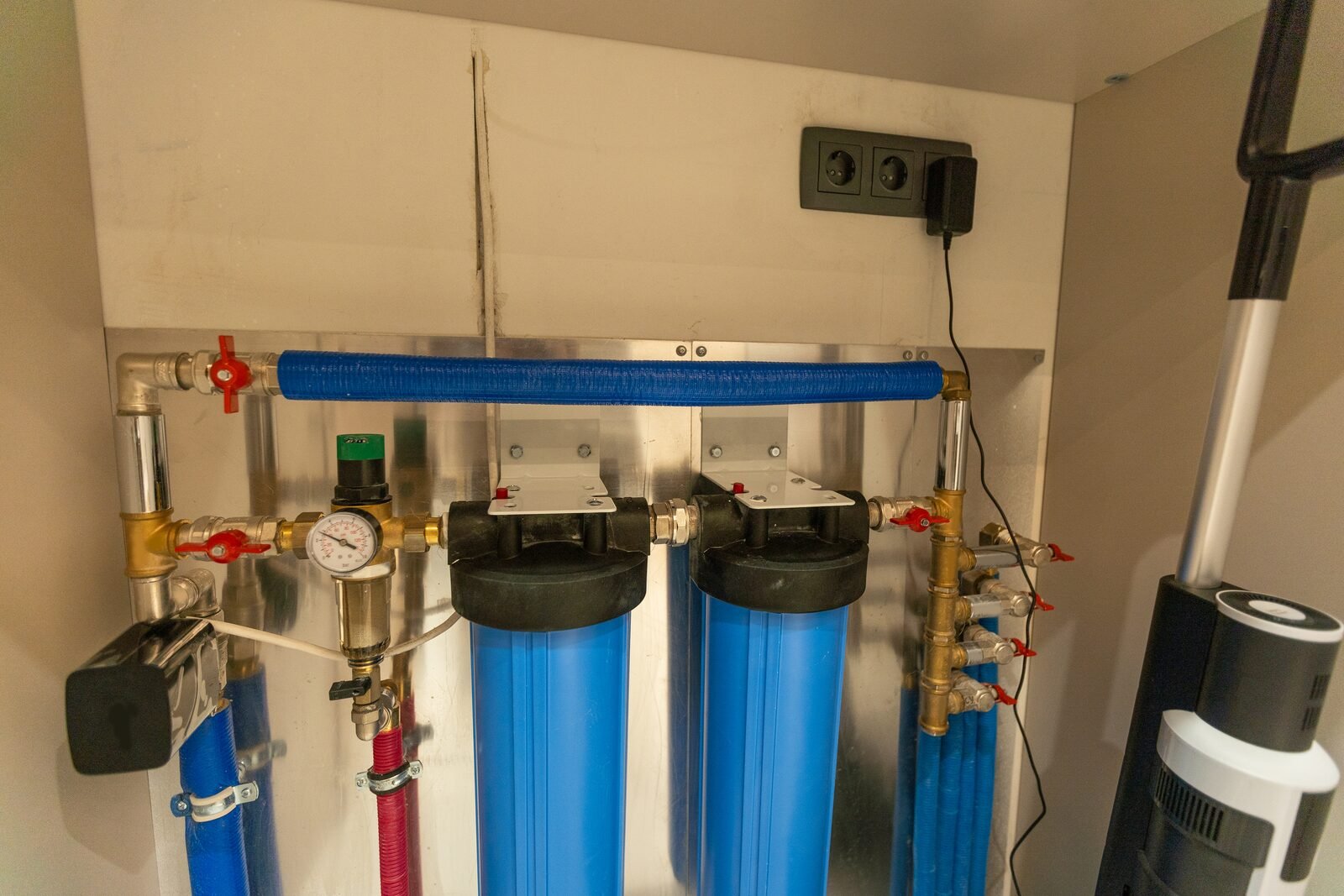
First, a sediment filter removes sand, silt, and particulate matter. A Clack auto-backwash unit cleans itself on a schedule, flushing trapped debris to drain without requiring manual maintenance. Next, an iron and sulfur filter (also Clack) passes water through an air pocket that oxidizes iron and sulfur compounds, trapping them before they reach the fixtures — auto-backwash again handles the maintenance automatically. Hard water minerals (calcium and magnesium) are removed by a water softener: resin beads capture the ions, and periodic brine regeneration flushes them out. Finally, a UV disinfection system — preceded by a 5-micron sediment filter and a charcoal filter to remove remaining debris and chemicals — kills bacteria and parasites with ultraviolet light.
Treated water flows into a cold water manifold that distributes to all fixtures. Because softened water has a slightly elevated sodium content, the outdoor hose bibs and irrigation feeds bypass the softener — plants don't need softened water, and it's better for them if they don't get it.
Hot water
A heat pump hybrid water heater handles primary hot water generation. It works on the same principle as the HVAC heat pump — extracting thermal energy from ambient air rather than generating it through resistance heating — with electric heating elements stepping in for peak demand. Secondary input comes from the geothermal system's waste heat: the compressor generates heat as a byproduct, and a desuperheater captures that heat to pre-warm water entering the tank, reducing the energy needed to reach temperature.
Hot water distributes via manifold, mirroring the cold water layout. For a house this size, sub-manifolds in remote sections and dedicated hot water recirculation loops keep hot water instantly available at fixtures rather than requiring a long wait while the cold water in the pipes flushes out.
Smart fixtures
A Moen smart shower system handles the master bathroom, where two occupants with different temperature preferences share the shower. A digital thermostatic valve maintains independent temperature control for up to two outputs simultaneously — each person's preference is stored and recalled on demand, without any manual adjustment. In other locations, freeze-proof yard hydrants (like Aqua-Vet V2) replace standard hose bibs, with an automatic drain that prevents freezing regardless of ambient temperature.
A reverse osmosis filter at the kitchen sink purifies drinking water, the refrigerator supply, and the ice maker — appropriate for a home with softened water, since softened water (while safe) isn't ideal for drinking in large quantities.
Sensors everywhere
The water system is only as smart as the data coming out of it. The sensor strategy here is deliberately dense. Leak detectors go at every point of use — under sinks, dishwashers, washing machines, refrigerators, and toilets — anywhere water damage could start undetected. Flow rate monitors go at key distribution points: the well discharge, and within each sub-manifold. This enables tracking water consumption down to the specific location (bathroom, laundry, kitchen), making it easy to spot unusually high usage before it becomes a problem.
Temperature sensors on the geothermal loop inputs and outputs monitor system efficiency. A salt level sensor on the water softener sends an alert when the brine tank needs refilling before the softener regeneration cycle fails. Valve actuators throughout the system allow remote shutoff — if a pipe freezes, if a leak is detected, or if a specific line needs to be isolated, it can be done from a phone without physically reaching the valve.